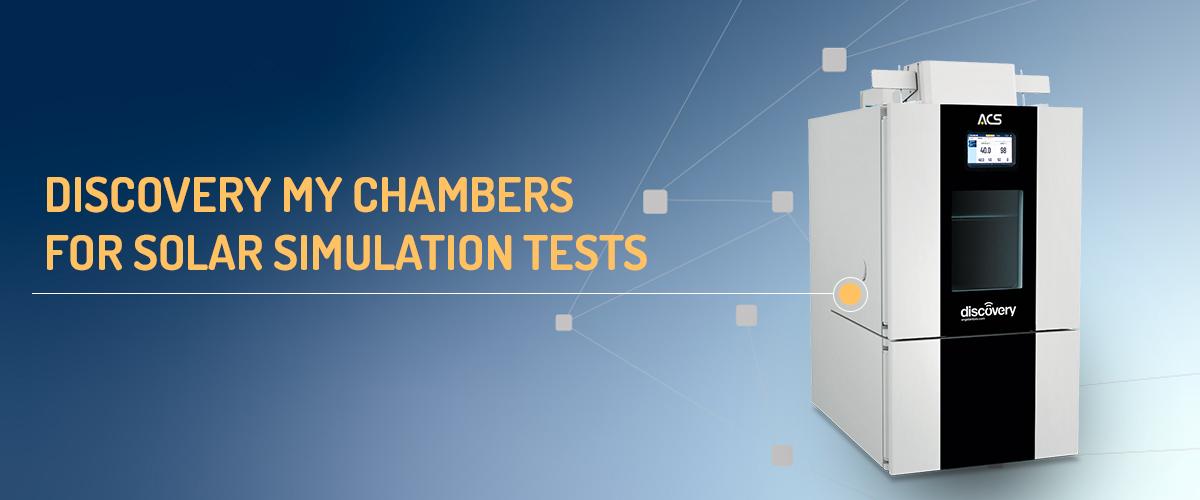
Solar irradiation testing without compromise by ACS: robustness, certified uniformity, and high-precision control
Solar radiation is one of the primary environmental stress factors affecting the durability, performance, and reliability of materials and products exposed to the outdoors.
Prolonged exposure to sunlight can cause photochemical degradation, discoloration, thermal stress, and a loss of mechanical properties.
To evaluate these effects in a controlled and repeatable manner, manufacturers use climatic and thermostatic chambers specifically designed for solar simulation testing. These systems allow for the simulation of real-world environmental conditions, significantly accelerating test times.
The Impact of Solar Radiation on Materials
Solar radiation consists of several spectral components - ultraviolet (UV), visible, and infrared (IR) - which contribute in different ways to degradation processes:
- UV radiation triggers photochemical reactions such as the breaking of polymer chains and oxidation
- Visible light contributes to color changes and surface alterations
- IR radiation generates thermal loads that cause expansion and mechanical stress
Under real-world conditions, these effects combine with variations in temperature and humidity. Accurately reproducing this complexity is essential for a reliable product validation.
Discover the features of ACS solar simulation test chambers
Within the Discovery My range of climatic and temperature test chambers, ACS offers a dedicated version for solar simulation testing, available in both the standard configuration and the ES (Environmental Screening) version, with a temperature change rate of 5 K/min.
Solar Simulation Technology
These chambers incorporate a simulation system designed to accurately reproduce natural sunlight conditions.
The lamp group is designed to ensure durability and stability:
- Anodized aluminum frame
- Stainless steel fixing components
The performance of solar simulation chambers is determined by the accuracy and stability of the light irradiation delivered to the test samples.
These systems can achieve irradiation levels of up to 1150 W/m², enabling significantly more intense accelerated exposure conditions than natural sunlight, while maintaining a controlled and repeatable environment.
The irradiated area varies depending on the chamber’s size and configuration, ensuring uniform exposure for different types of samples, further optimized by controls and monitoring via apyranometer and blackbody probe.
The irradiation intensity is continuously adjustable via an HMI interface, allowing for precise control of test conditions.
Integration of Environmental Control
In addition to solar simulation, the chamber allows for precise control of environmental parameters:
- Temperature over a wide operating range
- Relative humidity for simulating different climates
- Combined profiles with synchronized radiation
This integration enables the performance of multi-factor accelerated tests, reproducing in the laboratory the typical degradation mechanisms found under real-world conditions.
System Design and Operational Flexibility
The system is designed for maximum flexibility of use.
A removable internal plug allows the chamber to be configured:
- As a solar simulation chamber
- As a standard chamber (without lamp)
The inspection window is equipped with a removable cover panel, which prevents unwanted light interference during testing while also protecting the operator.
Maintenance is simplified thanks to dedicated design features, such as the easy replacement of the lamp bulb, reducing equipment downtime.
Industrial Applications
Solar simulation chambers are used in various industrial sectors:
- Automotive (interior and exterior components, plastics, coatings)
- Electronics (outdoor devices)
- Building materials (aging analysis)
- Aerospace (validation under extreme conditions)
- Photovoltaics (module durability and performance)
Typical tests include accelerated aging, UV exposure combined with thermal cycles, and hot-humid testing with controlled irradiation.
Compliance with International Standards
The chambers are designed to meet the major international standards for environmental and solar radiation testing, including:
- DIN 75220
- IEC 60068-2-5
- ISO 9022-9
- MIL-STD 810 (F and G)
- DEF STAN 00-35
- VDA 230-219
Depending on the test procedure, specific configurations or additional accessories may be required to ensure full compliance.
Conclusions
Climate and thermostatic chambers for solar light testing represent an advanced solution for the controlled simulation of complex environmental conditions. The integration of solar radiation with precise temperature and humidity control enables reliable and repeatable accelerated testing.
The use of these systems enables manufacturers to anticipate degradation phenomena, optimize product design, and ensure long-lasting performance, making them essential tools for research, development, and validation activities.
Click here for available models and accessories.